

READ OR LEAVE A COMMENT
SHARE POST
There is a version of me who used to paint until 3am.
She would lose herself entirely in the work. No one was waiting, there were no sounds to listen for. And no part of her attention angled toward a room down the hall or a baby monitor. She could disappear for hours, and at the time, that felt like one of the purest expressions of who I was.
That version of me no longer exists.
And I can say that honestly now without the fear that honesty means regret.
Do I miss the ease she had access to sometimes? Yes.
Do I wish for her instead of the life I have now? Not for a second.
Do I love what motherhood has given me, and who I have become inside it, with all my heart? Completely.
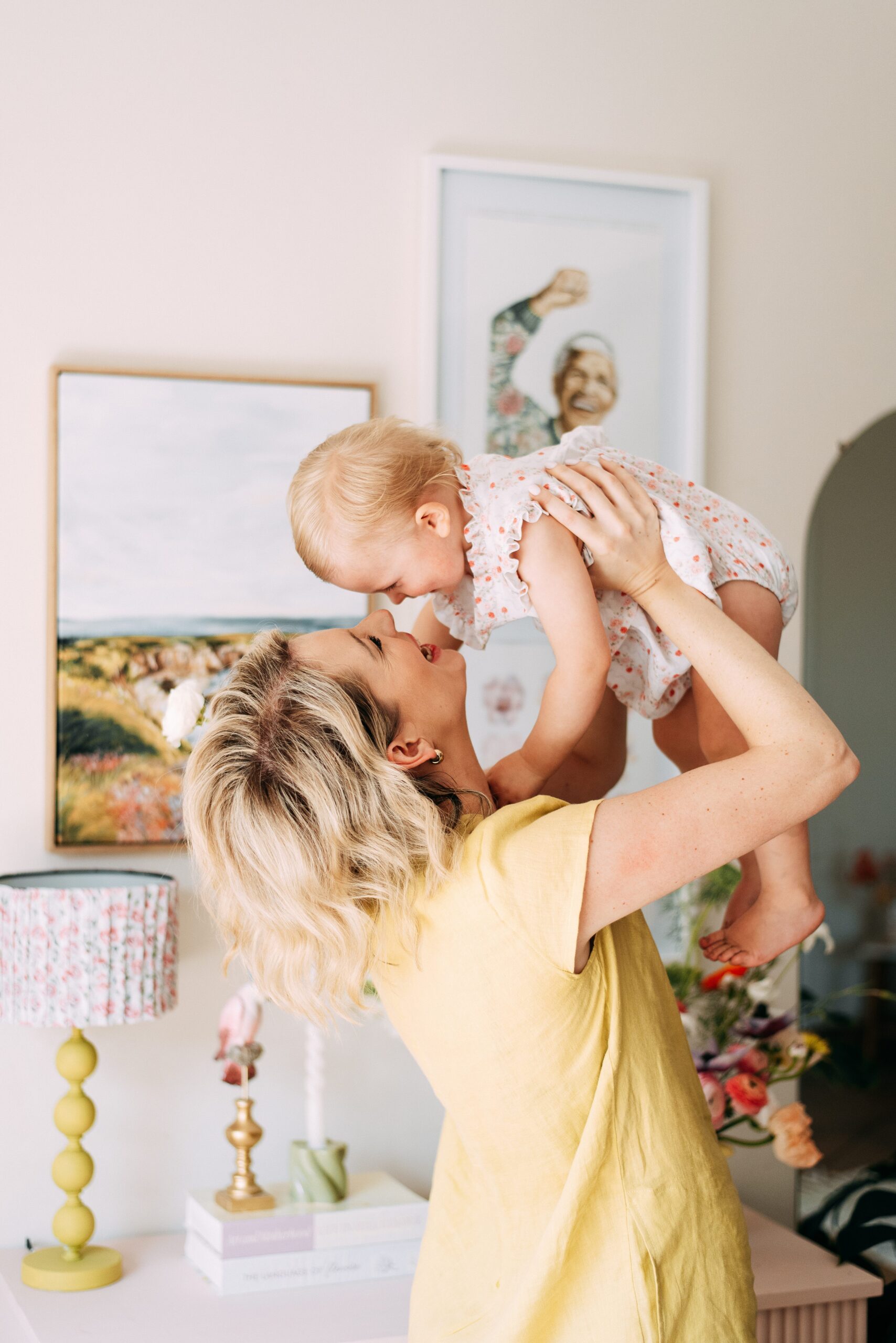
Because becoming a mother did not take me away from my real life. It brought me deeper into it.
It stretched me, humbled me, re-ordered me, and introduced me to a kind of love so profound that it changed the scale by which I measure almost everything. I wanted my daughter wholeheartedly. I love being her mother more than I can properly put into words. And still, I think there is value in naming that when a woman becomes a mother, something about the way she once moved through her creative life changes too.
Not because the blessing is in question.
But because the shape of devotion changes.
And I think both truths deserve to be spoken with care.
I knew there would be sacrifices, but no one named them like this.
Everyone who had been a mother before me offered some version of the same advice: you will never have enough time to do it all.
They were right, technically, but they named the wrong thing.
What I had not understood before becoming a mother was that you do not simply lose hours. You lose the uninterrupted quality of your attention to anything else. The assumption that when you sit down to create, you can belong completely present to the work for as long as you need to.
The thing about artists is that our attention is fuel. We make things out of it.
And when you become a mother, your attention is no longer fully yours. Not during the studio session or during the nap window. Not even during the quiet cup of tea at 6 am that you thought would be yours to think in.
There is always a part of you listening. It’s the invisible string.
Before I had my daughter, I honestly feared what slowing down would mean. I remember the specific anxiety of it: what if I lose momentum? What if I fall behind? Does having a child stop making me an artist and turn me into a mother who sometimes paints? For context, I’ve been painting since I was 6 years old, and there isn’t a version of me I’ve lived that hasn’t held a paintbrush.
After she arrived, I spent a long time trying to recreate conditions that no longer existed, waiting for a version of making that was not going to return in the form I recognised.
And yet, even there, I can see grace now.
Because for all the freedom I once had to disappear into the work, nothing has compared to the love I have come to know in motherhood. Nothing has expanded me quite like this or taught me devotion more honestly. Nothing has made me hold both tenderness and discipline with such intention.
Motherhood did not take my creativity.
It rearranged my schedule, deepened my values and refined my motives.
More quietly it slowly rearranged the conditions inside which I create.
The creativity remained, but the conditions changed, and that is something very different from losing it completely.
What it actually feels like to be divided
There are things that feel acceptable for us to carry in private, but harder to say aloud.
So in honour of Mother’s Day weekend, I want to let you in on one of the quieter wrestles of being both artist and mother.
I often feel divided, and for a long time, I’ve carried it as a kind of low-grade shame.
When I am in the studio, one ear is open for the sound of small footsteps. When I am with my daughter, I am sometimes mentally sketching the motif I left unfinished on the desk. It’s difficult on some days to feel entirely in either place, and I thought it meant I was failing at both.
But three years in, I have come to understand something gentler and truer: feeling divided is not the same as being absent. It is the permanent weather of loving two things deeply at once. And devotion is not diminished by division. It simply takes a different shape.
That reframe has been so healing and matters so much to me because I never want women like us to think that feeling the tug of both means we are somehow less grateful, less present, less wholehearted.
It does not.
It means we are living inside the real tension of a full life. A life where love has multiplied, not simplified.
There is also a particular loneliness in this that I want to name for creative women, because I do not think it gets acknowledged enough or said aloud.
Not the loneliness of not having people around you. The loneliness of carrying something that others do not always understand the weight of. The ache of a creative calling that cannot be set down and also cannot always be fully picked up, and no one around you quite recognises that as the particular kind of hard it is.
If you have felt that, I want you to know: it is a real thing.
You are not dramatic for feeling it and you are not ungrateful either.
You are simply someone for whom creativity is not a hobby that can be tucked away without consequence. It is a gift buried deep within you. A way you serve, earn and a way you return to yourself. A way you respond to what God has placed in your hands.
And the conditions changed, not your calling, just the conditions.
Does feeling divided make you less of a mother or less of an artist? No.
I believe it makes you someone who is called to both with full devotion, in a life that asks for daily surrender and daily returning.
It’s not a flaw in you, it’s the shape of this calling.
The practice nobody is clapping for
Something I have often thought about along the journey is that nobody is waiting to see if you return to the paintbrush.
Not in the way someone might notice if you gave up on something outwardly visible. The creative work you do in the margins of motherhood is largely invisible to everyone around you. There is no external accountability. No audience for trying. No one is particularly concerned if the brush goes back in the jar or drawer without being used that day.
Which means that every time you choose to return to making, you are doing something that belongs entirely to you.
You are showing up for your calling in private, with no applause, often with fifteen or twenty minutes and the beginning of something that may not go anywhere that day.
And I think that is one of the most quietly powerful things a creative woman can do.
Before motherhood, you might have created because you had time, and fire, and long unbroken stretches where the conditions welcomed you in.
Now you are creating in the face of limits, and you are still choosing it anyway.
You are saying, by coming back after the interruption, after the nap ended too soon, after the day that left you hollowed out: this still matters. This is still worth returning to.
Half-finished is not the same as abandoned, and an interrupted making session is not a wasted one.
Choosing to begin, even knowing you may be stopped before the end, is another level of devotion. A steadier one. A quieter one. One that asks less for performance and more for faithfulness.
Because you are not creating from an abundance of attention anymore, at least not in the way you once knew.
You are creating from commitment and from stewardship.
From love for what you know you have been given and from the belief that this, too, is worthy work.
And that is a thing nobody may clap for, because they cannot always see it.
But you will know it is there.
For me, the simple art of returning is one of the most powerful practices of being an artist-mother. Every return is a declaration:
I am still this.
The work still matters.
I am not waiting for a quieter, easier, more predictable season to be who I am.
You are saying that to yourself every time you pick it back up, whether the world notices or not.
Yes, a licensable pattern collection can be built in nap-time fragments
My first significant licensed collection did not begin with a production schedule or uninterrupted studio weeks.
It began with a single artwork. Painted during nap windows, between twenty and forty minutes. I had one intention: not to finish something, but to make one element come alive. I knew she might wake before I was done and I chose to begin anyway.
That piece became the seed of a collection. That seed was seen by a brand. That brand said yes. And now I create collections for them twice a year annually.
The story may sound neat in hindsight, but the process of making it was anything but, and that is exactly why I share it.
Because if you are a woman reading this and quietly believing your creative process has to look a certain way to be legitimate, I want you to know what I have come to believe over my three years of making as a mother. You do not need ideal conditions to make work that reaches people. You need the courage to start in imperfect ones, and the willingness to let small faithful acts become the method.
Motherhood, strangely and beautifully, can teach that.
Once you stop resisting the fragment, something shifts. You stop waiting for the long, uninterrupted afternoon and begin trusting the small pieces. And once you trust the pieces, and keep returning to them, you realise that real work can be built this way too.
Here are some of the practical things that helped me build in the margins:
Work with a single intention per session
Not, I will work on the collection today.
But, I will paint this one element.
When the nap ends at twenty minutes, the small thing still got done. And small things accumulate. Small things still grow into complete collections.
Prepare during wakeful hours that you cannot use
Set up your workspace, lay out your colours, open your reference images, and make preparation part of the rhythm. Then, when the window opens, there is no barrier between you and beginning.
Tolerate the fragments and pieces
This is the real skill, and no productivity system will teach it to you. The ability to put the brush down mid-session and trust that you will find your way back is what allows you to create through any season. Not finishing is not failing. It means you will return.
Redefine what a successful session looks like
One motif completed. One colour palette resolved. One composition sketched out. These are not consolation prizes. They are the method, the key pieces and over time, they become a collection.
The pace may be slower than you once planned, but that does not make the work any less meaningful.
What this season is building that you cannot always see from the inside of it
My definition of success looks completely different now than it did before I became a mother.
It used to live in visibility, growth, and external proof. I measured momentum by what was legible from the outside. Whether my following was growing, whether the announcements were impressive, whether the pace looked like progress to anyone watching.
Now success looks like sitting down in a quiet house and choosing the brush when no one expects it. It looks like staying aligned with what I actually value. It looks like building something I would be proud for my daughter to understand one day, when she is old enough to know what it took to hold onto it in the margins.
Motherhood stripped away some of the things I was chasing that were not truly mine. It has paved the way for better boundaries, slower decisions, and a business that finally fits around life instead of consumes it.
I no longer allow work to push into the hours I have carved out for presence and being “all there”. I have also learned that exhaustion does not have to define the whole identity of a season, I stopped just saying “I’m tired” when someone asked and thought about the other things that were still true. Tired has its place, it’s kind of a baseline, but it can become a whole identity if we allow it.
I have decided I would rather be divided, feeling fully alive in both directions, than waiting for a season to end before I allow myself to begin.
And yes, there is a version of creative life that asks you to table the making until conditions improve, until the children are older, until you have more to show. I understand and respect that instinct deeply.
As long as we remind ourselves not to stay hidden, waiting for perfect conditions that never come. Often, I think we have to risk building messily alongside real life, or we end up waiting forever for the imaginary one.
What motherhood has given me as an artist is this: self-trust beyond perfect circumstances. A deeper attention to the small things. A business that finally knows what it is for.
It has also given me truths I could not have believed before:
A slow pace is not a failure if you make it your method.
Interruption is not an obstacle if you let it become part of your practice.
And a collection built between nap times, on a farm, in the margins of a real and full life, can still reach brands on the other side of the world.
Showing up on the days you feel divided is still showing up devoted.
It always was.
If you’re in this season too
If you are in the middle of building a creative business while raising a family, and if some part of you needed someone to name what this actually feels like without reducing motherhood to burden or creativity to indulgence, I hope this was that.
And if you are wondering whether it is possible to turn what you make in the margins into something commercially real, into a portfolio that reaches brands and a licensable collection that travels into the world, I want you to know that it is.
I have done it, and I am still navigating it in the exact kinds of conditions you may be in now. It has been so beautiful, challenging, and so worth it.
The Art of Belonging is a mini course I created to help women in transitional seasons return to a version of themselves that isn’t weighed down by comparison and the feeling that she’s behind just because the pace looks different.
I believe that if it’s on your heart to keep creating, you don’t have to wait for when life is quieter or neater.
You can build alongside motherhood, in the season you are actually in, and feel fulfilled doing so.
If you’re creating in a way that technically “works,” but still feel hesitant, hidden, or unsure all the time, this may be the gentle permission you’ve been looking for to dive deeper within yourself and shift into a steadier, more confident version of the artist you already are.


