

READ OR LEAVE A COMMENT
SHARE POST
In 2022, I booked a portfolio review with art licensing agent Jennifer Nelson, and it quietly changed the way I build everything.
Until then, I had started building my collection library by making whatever I felt inspired to make. Florals one week, woodland animals the next. Thw work was lovely, but it had no relevance within the framework of a commercial calendar. I was not thinking about Christmas, Valentine’s Day, or the evergreen seasonal themes that serve as the backbone within a retail year.
I was only thinking about inspiration and Jennifer helped me name something that had completely escaped me: the commercial structure beneath art licensing. The realisation that landed during that conversation was simple and slightly humbling. My art licensing portfolio was not missing talent. It was missing structure.
If you have ever sat with a sketchbook full of work you love and still felt as though nothing was quite landing with brands and wondering why, I want to gently offer you that same realisation today.
Your art may already be ready. It might simply need to be curated into the themes buyers are actively searching for.
In this post, I am going to walk you through four seasonal themes I believe every art licensing portfolio should include, why buyers need them, and how you can make each one feel unmistakably yours.
Let’s bust a myth first: original art is not a design brief
Yes, originality matters deeply, but in licensing, originality is expected. You being the author of your work is the price of entry, but on it’s own is most likely not enough to get licensed.
When a brands look for art to license, they are rarely using the search term “unique art.” They are searching by season, category, product and by the commercial need sitting on their calendar. Your style still matters enormously, but it’s often what they discover after a relevant theme has led them to you.
I was concerned that creating toward a market theme would somehow dilute my work or make me less unique and I think many artists carry that fear. But honestly, by avoiding it I was keeping my art licensing portfolio smaller than it needed to be because I was holding out for a feeling instead of building the doorway buyers were already looking for.
What changed my mindset and strategy was really understanding that art licensing serves a commercial need. If you want to license your work, you need to understand the themes, seasons, and product moments brands are already planning for.
This doesn’t mean abandoning your voice and only copying trends. I think we defeat the point of making art that connects if you yourself are disconnected from your work. But it does means meeting a recognisable need through your own visual language.
And if that feels completely disjointed from the way you want to make art, then licensing may not be the best path for you. Creating independently and building your own products on your own terms is a beautiful path too.
But within licensing, there is a commercial calendar that we as artists need to understand. I say this because the proof, for me, was personal. It was after creating what was only my second holiday collection, still in pieces, that led to one of my biggest licensing partnerships.
Understanding the licensing calendar
It’s not quite a secret but you can be oblivious to it, and once you know about it, it changes everything. It’s that brands work months, and sometimes more than a year, ahead.
While you are enjoying the first warm days of summer, a product developer may already be signing off on Christmas. When the shops are filled with Valentine’s cards, a buyer may be reviewing autumn florals. Brands are thinking in launches, retail windows, gift seasons, production lead times, and customer buying moments.
This is why seasonal themes are not a creative compromise. They are the need your future partners already look for. The moment I began creating more thematically, a lot more licensing opportunities opened up. It also quietly curbed my need to feel inspired before I could begin, which on its own is worth everything. A theme gave me a starting point, a commercial need gave the collection direction and my style was still the thing that made it mine.
So let’s walk through four themes that belong in a commercially useful art licensing portfolio, along with ways to make each one feel true to your own work.
Theme one: Christmas and winter holiday
If you build only one seasonal collection this year, make it this one.
Christmas is one of the most commercially powerful seasons in licensing. It is an essential part of an art licensing portfolio because the need is annual, predictable, and broad for interpretation.
Christmas artwork can move across:
- Wrapping paper
- Greeting cards
- Ornaments
- Bedding
- Fabric
- Tableware
- Stationery
- Home décor
- Children’s products
- Seasonal gifting
But here is the beautiful part: the commercial need may be consistent, but your interpretation is what makes the work distinctive.
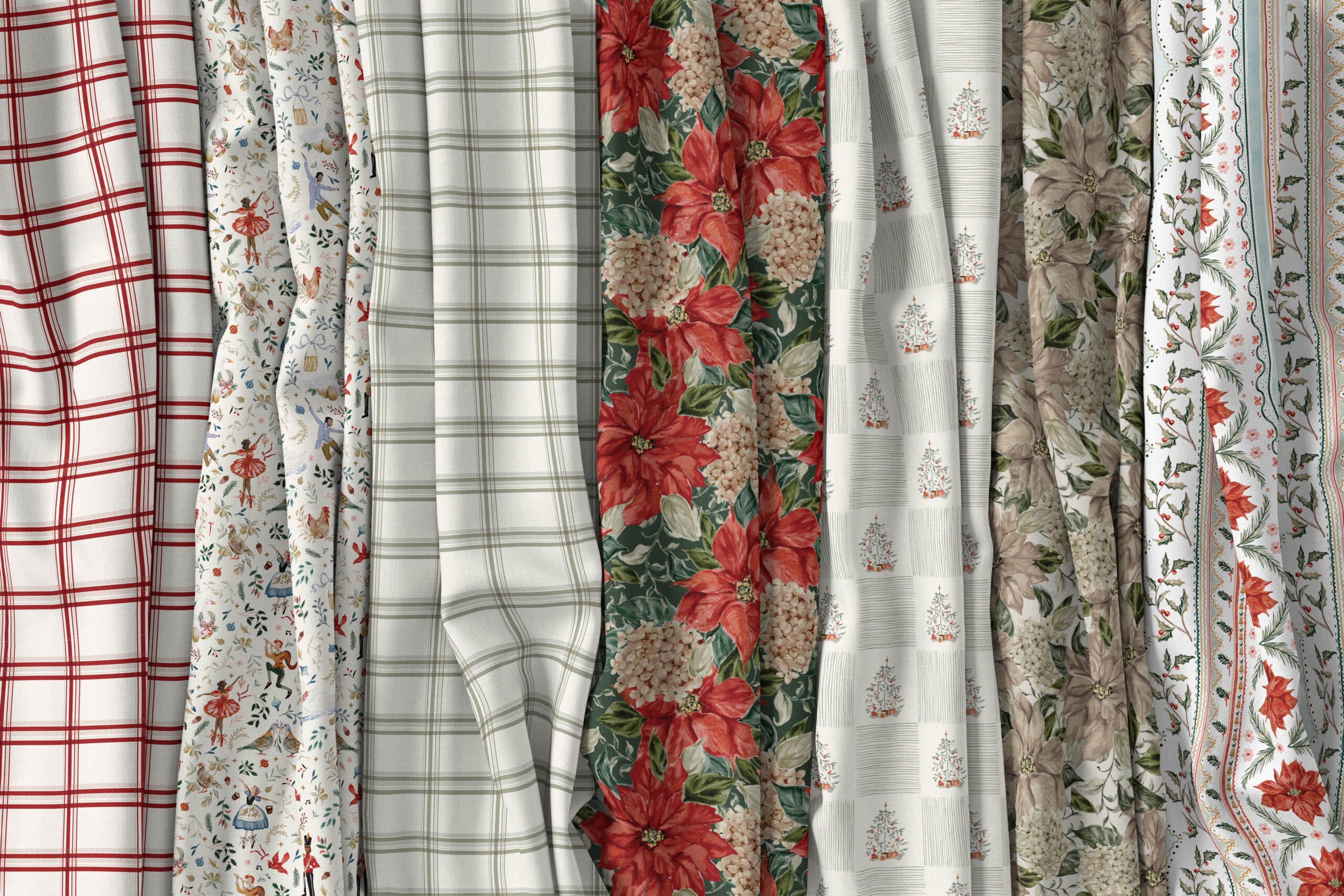
Think nostalgic folk patterns. Traditional botanicals such as poinsettias and winter greenery. Soft watercolour forest creatures. Snowy landscapes. Stars, ribbons, ornaments, bells, and bows rendered in your own hand.
A brand already knows it needs Christmas artwork. Your job is to offer a version that feels novel but relevant. Like something familiar, but not something they have already seen everywhere else.
A focused Christmas mini collection might include:
- One hero pattern
- Two or three supporting coordinates
- A gift-wrap placement
- Two greeting-card designs
- A decorative border or lettering piece
Your takeaway: Build at least one cohesive Christmas collection while much of the world is still thinking about summer. Buyers and product developers work far ahead of the season customers eventually see in stores.
Theme two: Valentine’s Day, and don’t let the hearts fool you
Valentine’s Day is one of the themes artists often underestimate, and that is exactly why it can be an opportunity.
This season is not only about romantic love. It is also about gifting, friendship, family and affection. It’s a little card slipped into a lunchbox, a mug passed between colleagues, a Galentine’s celebration that has quietly become its own retail moment.
When I stopped thinking only about couples and started thinking about small acts of love, my whole approach opened up.
Suddenly there was room for:
- Children’s pajamas
- Pet illustrations
- Friendship cards
- Playful love notes
- Floral gifts
- Parent-and-child themes
- Whimsical characters
- Sweet, non-romantic sentiments
My Pawfect Love collection grew from this broader idea of affection. Dog illustrations, playful tiles, flowers, and tiny moments of humour gave me a way into the season that still felt completely natural to my work.
Brands need a fresh interpretation of love every year. That is the gift of this theme for your art licensing portfolio. The commercial need returns annually, but it is always game for a new angle.
A Valentine’s mini collection might include:
- One playful hero print
- A simple coordinate
- Two character placements
- A friendship card
- A gift or apparel mockup
Your takeaway: Design a Valentine’s collection that speaks to gifting, friendship, family, pets, or small acts of affection, not romance alone. Brands want warmth and personality, not just another generic heart pattern.
Theme three: Spring and Easter
After winter, something in all of us reaches for lightness and buyers feel it too.
We look for fresh colour stories and breathing room. The market turns toward florals, butterflies, ducks, chicks, bunnies, garden scenes, soft pastels, gingham, ribbons, and the timeless feeling of life beginning again.
Spring and Easter artwork moves beautifully across so many products. Think bedding and cushions. Fabrics for little ones. Greeting cards. Gift wrap. Nursery décor. Stationery. Or the entire tablescape of a spring gathering, from napkins to crackers tied with ribbon.
This is one of the most versatile themes you can include in an art licensing portfolio because it can live equally well across nursery, home, fabric, stationery, and gifting categories.
The emotional pull here is lightness, colour and freshness. When your spring collection carries that feeling, it does not simply decorate a product. It gives someone a small sense of transitioning into something new.
A spring mini collection might include:
- A garden-inspired hero print
- A gingham or stripe coordinate
- A rabbit, duck, or chick placement
- A floral greeting card
- A spring tablescape or nursery mockup
Your takeaway: Curate a spring collection built around freshness, softness, and renewal, then design it to flex across home, nursery, stationery, and gifting categories.
Theme four: Autumn and fall, the quiet opportunity
This is the theme I want you to pay special attention to because it is the one many artists overlook. And as a South African artist, I almost overlooked it too.
We do not experience Halloween or Thanksgiving with the enormous retail focus they carry in the United States. It took me time to recognise how commercially significant the autumn season is internationally. Those holidays fill the long retail window before Christmas, and brands still need fresh artwork on shelves throughout that period.
Once I began studying the international market more intentionally, Autumn stopped feeling like an afterthought and started looking like an opportunity. It is the quiet space between spring and Christmas.
Fewer artists build strong autumn collections, which means the buyer searching for harvest themes, warm foliage, woodland creatures, pumpkins, mushrooms, moody botanicals, and cosy colour palettes may have fewer suitable portfolios to explore.
I think of autumn as the season of warmth turning inward. The palette does much of the emotional work here. Ochres, rusts, warm browns, berry tones, deep greens, and muted blues can make a fabric feel like a cup of tea on a Fall afternoon.
A considered Autumn range can give your art licensing portfolio more international relevance and help you compete in a quieter room. And in licensing, a quieter room can be a room of opportunity. It is often where aligned partnerships begin, simply because there is more space for your work to be seen.
An autumn mini collection might include:
- A woodland or harvest hero print
- A foliage coordinate
- A mushroom, pumpkin, or animal placement
- A cosy seasonal greeting card
- A home décor or fabric mockup
Your takeaway: Do not overlook Autumn, especially if you live outside the US. Study the international calendar, and let a thoughtful fall collection give your portfolio a useful point of difference.
How long does a seasonal collection actually take?
One of the quiet reliefs of seasonal work is that it does not have to take forever.
A seasonal collection can be a mini collection that only take a few weeks. Five patterns and three placements might be enough to connect with a brand.
It is focused, serves a clear need and then it is ready to share. My evergreen collections are often a different kind of project. I like them to be deeply story-led and illustration rich, and sometimes they can take months. They might contain ten to twenty patterns, along with a range of placement prints suitable for greeting cards or wall art.
I think both kinds of work matter and each artist gets to decide what kind of rhythm they can keep for the season they are in.
Understanding that mini collections are valuable too frees you from the belief that every addition to your art licensing portfolio needs to become a months-long labour of love before it earns its place. A focused seasonal collection can be commercially valuable without being enormous.
Your takeaway: Give yourself permission to build tight, intentional seasonal mini collections. Done and shareable will move you forward faster than perfect and hidden.
The misconception that keeps talented artists stuck
Many of us assume that if we are “good”, our work is automatically licensable.
It isn’t entirely untrue, but talented artists stall all the time, or take the long way around because their work is not yet structured to be easy for buyers to view, understand, and use. There is absolutely room for artists who are creating intentionally and building beautiful work.
The difficulty arrives when we ignore to recognise art licensing as the commercial service it is. We end up holding up our work and waiting for a yes, rather than building an art licensing portfolio we can regularly update, share, and pitch to aligned brands.
I have lived both sides of this because for a long time, I believed working harder would move me forward. More hours, more dedication and more artwork. And I did work incredibly hard. But the effort gave me more work, not necessarily more progress. I was burning myself out instead of growing my portfolio or scaling my business at a sustainable pace.
It became a hamster wheel I’ve taken three years to recover from and it’s exactly why strategy matters so much to me now.
Strategy outlines:
- The container in which you get to create.
- The commercial need.
- The timeline.
- The person you are creating for.
- The reason this collection needs to exist.
Then there is not only talent behind what you make, there is purpose.
Doubt is a stage not a stall
No matter how much art you make, the self-doubt will still come. It still comes for me, in those vulnerable moments of sharing, asking whether I am truly cut out for this.
But if you have a process and purpose, you can accept that the doubt is going to arrive no matter what. Because the process allows you to move that doubt through the work instead of allowing it to stop the work.
The thing that carries you through the dip is rarely your feelings (I certainly can’t rely on mine). 10/10 times it’s my structure that pulls me through. If making it through depended on how inspired or confident we felt on any given day, most of us would stop the moment the first excitement wore off.
And on the other side of that dip is the reward I wish every artist could experience:
Seeing your artwork in the wild.
Watching a brand build an entire product range or experience around something that began as a small painting on your desk is truly remarkable.
So remember that creating for a commercial need does not make your work less original. It makes your originality easier to find. The commercial need is consistent. Your interpretation is unique.
That is the whole point.
Does your art licensing portfolio hold these four themes?
Before you begin your next collection, take a gentle audit of the work you already have.
Does your art licensing portfolio include:
- Christmas and winter holiday
- Valentine’s Day
- Spring and Easter
- Autumn/Fall
Then ask the more interesting question:
What would my interpretation of each of these familiar themes look like?
And if you are the overwhelmed artist reading this, wondering whether your work is ready to belong in the world, I want you to feel relief. The fear you are carrying is not evidence that you are incapable. It is something almost every artist carries when they begin creating with commercial intention.
The structure I have explained here is not reserved for a lucky few, it’s yours too. When you learn to trust the process more than the feeling, you can begin sharing and pitching your work with greater steadiness. The doubt may keep arriving, but it no longer gets to define what you build.
Need more collection ideas?
I have put together a free guide called 50 Portfolio-Ready Collection Themes for Artists, complete with motif ideas and a little market context for each theme.
It is the resource I wish I had back in 2022, when I was sitting with a portfolio that was full of heart but short on structure.
To receive a free copy, sign up here.
You can also continue exploring more about building a licensable body of artwork here on the blog.
I hope this moves you towards you next licensable collection!
If this post resonated, you might also love:


