

READ OR LEAVE A COMMENT
SHARE POST
There has been artwork that has lived on my hard drive for months.
I had painted elements for an entire collection. It had a theme, it had colour and it had the kind of detail that felt like a storybook when I looked at it. I knew what season it was for and I knew, in the way you know things you have poured yourself into, that it was some of the loveliest work I had made in a long time.
And I never pitched it.
Not because the file was not ready.
Not because I didn’t have a brand in mind.
But because something in me kept asking:
Is it ready?
And that question has a way of keeping a lot of beautiful work hidden on a hard drive for longer than it should. So if you have ever finished a pattern collection and then hesitated at the moment of sending or sharing, this post is to let you know you’re not alone and how to push past the “Is it ready” question.
The 3 readiness myths we all believe
If I’ve learned one thing about art licensing, making and pitching it is that readiness does not arrive like a lightning bolt. In fact, it feels a little more like standing on a ledge instead of a warm “welcome home” banner.
It doesn’t come after one more pattern, one more lookbook, one more round of self-doubt ( you know the shifting of elements 2mm to the left and right only to move them back to their original place).
If it did, more artists would be pitching their work regularly and yet so many of us aren’t just waiting for “readiness” to arrive, we’re waiting for it to feel more comforting than it is.
We treat readiness as a need before action, when really, readiness is often the result of action.
This is the first myth I want to gently reframe: that you need to feel ready before you do something that matters to you.
The second myth is equally powerful: that confidence comes before courage.
It does not, at least not in my experience.
Courage is what you feel when sharing the work is scary and you decide to do it anyway. Confidence is what builds slowly, quietly, following the action of having done the thing you were afraid to do.
If you are waiting for confidence to arrive after you’ve designed your collection – before you pitch, you may just be waiting for something that only comes from the act of pitching itself. I used to tap my finger on the desk three times before hitting send, almost like a friend standing behind you saying “1,2,3” before they push you into the pool you said you wanted to swim in. I don’t think I’ve had to do that for over a year, mostly because I now know jumping in is what I signed-up for, that it’s better than waiting on the edge.
The third myth is this: that perfection is the same thing as preparedness.
It is not, and if you take one truth from this post I hope it’s this one because it kept me feeling stuck and hidden for years waiting for “perfect timing” and “perfect work” before I was ready to start licensing my art.
Perfection is imagining an ideal outcome but never experiencing it. Preparedness is doing what you can to help the work be seen and understood, while accepting that you cannot control what happens next.
I have pitched collections that came back with a gentle no. I have also pitched collections that led to ongoing partnerships I now create for twice a year.
In both cases, the collection was not perfect , it was prepared, and those are very different things.
Understanding the distinction between the two might be one of the most useful shifts you make if you are learning how to build a creative business from the artwork you already make.
If you have mistaken perfection for preparedness, know that most artists do.
I certainly have to keep myself in check almost every time I get to the pitching stage.
When I start to get really hung up on tiny details that prevent me from pitching, I know I need to take a breath and ask myself if I’m waiting for perfect, or if I’m prepared to experience what this collection release has to teach me in what approach works and what doesn’t, who it’s for and who it isn’t for.
What readiness actually looks like
Here are four questions I ask myself before I ever type a single line of a pitch email.
1. Do I know the story of this collection?
Not in the vague sense of, Here I made this.
I mean really be able to place it in the real world. I ask if I can I describe the mood, the setting, the key imagery, and the feeling in two or three clear sentences? Not paragraphs.
Can I give an art director or buyer language they could actually use for their brand?
Language for a buyer.
Language for a product page.
Language for a photographer.
Language for their team.
Brands are not only licensing artwork. They are licensing a story they can build a product line around. When your collection has a clear narrative, you make their job easier. And an easier pitch is almost always a stronger one.
2. Do I know who this collection is for?
Not every company is the right home for every collection.
Knowing your niche and really knowing it, changes everything from the artwork you create to the brands you research to the way you frame the collection when you reach out.
A collection created for nursery wallpaper will not be presented in quite the same way as a collection created for stationery, quilting fabric, children’s clothing, or seasonal gifting.
The clearer you are on the kind of product world your collection belongs to, the easier it becomes to find aligned brands and speak to them with intention.
If you are still working out what niche means for your work, this post on what makes a pattern licensable goes into that in more depth.
3. Do I have visuals someone else can follow?
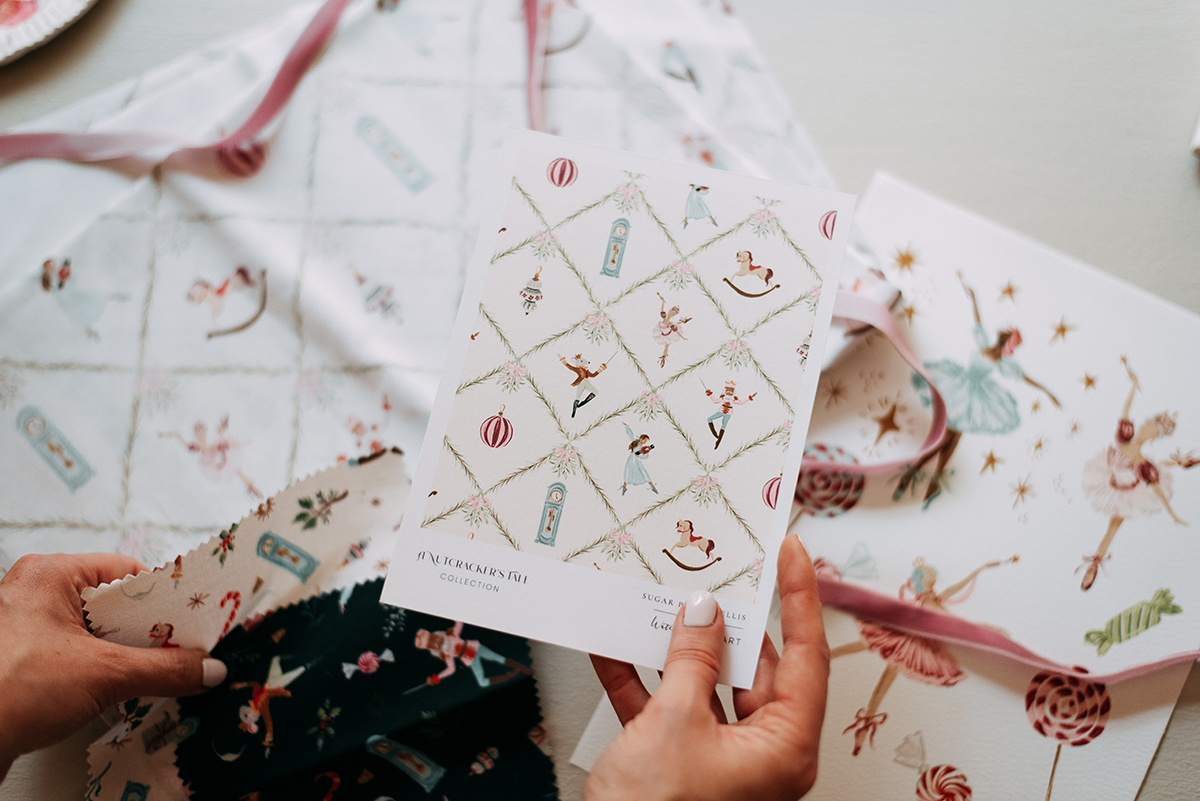
This is where your sell sheet or lookbook comes in.
A sell sheet is a clean, one-page low-res JPEG file that shows pieces your collection clearly, with your name, your logo, and your contact details. It does not need to be elaborate. It needs to be clear with 3-5 thumbnails of artwork. A good sweet spot for low res JPEG is to export it at 72 or 150 ppi (pixels per inch) and the file size could be between 1200 and 1800 pixels on the longest side so you want to aim between 300KB to 800KB per JPEG sell sheet if you can.
A lookbook goes a little further. It is usually a small PDF that shows your collection in context, sometimes with mockups, colour swatches, and a brief introduction to the theme. It tells the story before you have said a word all in one place.
A few beautifully laid out sell sheets is more than enough to begin, you do not need 20+ mockups.
At this point you need clarity and simplicity to share.
4. Can they open it without drama?
This sounds basic, but it matters.
Before I send anything, I ask:
- Can I send a Canva document view link or Dropbox link rather than a large attachment that might sit in a company’s blocked email?
- Can an art director open it on their phone while they are between meetings?
- Is artwork clear, legible, named and easily understood in a few seconds?
If the answer is yes, I am ready to send. Not because the work is perfect, because it is prepared.
And ready enough is a real thing.
The part most artists overlook
I keep noticing something again and again in the artists I work with through my mentorship and course work, which I thought would be valuable to name here too.
Most artists who say they are not ready have the skills.
They can paint.
They can digitise.
They can build a repeat.
They have ideas, taste, and a visual language beginning to form.
What they are missing is not always skill, it’s willingness.
Willingness to be seen before they feel certain.
Willingness to let the work exist in the world while it could have been something else.
Willingness to accept that a no is not a verdict on the artwork.
That last reframe has been one of the most freeing things I have come to understand about pitching, because when a brand does not respond, it does not mean your artwork is not worthy. It may mean the timing is off, the fit is not quite right, the category is already full, or the brand is working months ahead on something completely different.
It is often a seasonal issue.
A category issue.
A timing issue.
Not a talent or worthiness issue.
In my experience, when you begin moving from waiting to willing: the doing is the shift that opens you up. Doing the brave thing makes you braver.
Each collection pitched, each follow-up sent, each lookbook shared adds to a growing sense of your own capability. It opens you up to understanding that you are probably more ready than you think. I would gently suggest that you almost certainly are.
There is a possibility that the part that does not feel ready is not the work itself, but the willingness to let it be seen. It is one of the core reframes I teach inside Brush to Brand, my signature course for artists who want to take their creative practice into surface pattern design, art licensing, and more professional portfolio-building.
I like to teach that the skills are learnable, but it’s the willingness that’s a choice only you can make.
A recap on what is “ready enough”
If you are looking for a clearer set of markers, these are the five checkboxes that I use define ready enough before I send a collection.
- You know the story of your collection in two or three articulate sentences.
- You understand the niche or product category it belongs in.
- You have a sell sheet or lookbook that presents the work cleanly and accessibly.
- You know which brand or brands you are pitching and why they are a genuine fit.
- You have a way to share the work that does not involve a heavy attachment blocking someone’s inbox.
That is it.
You do not need a brand book that rivals a published magazine or every possible mockup.
Figured out means you have the artwork prepared. Meaning it’s organised, presented, and pointed in the right direction. I’ll tell you that done and organised will move you forward so much faster than perfect and hidden ever will.
Remember that you are not auditioning for worth when you pitch. You are offering your work to be seen by aligned brands, and inviting them to license it.
It’s such a different energy from what most of us bring to that moment of hitting send, and it is a much lighter way to carry your artwork into the world. Not to be measured but to connect and be celebrated.
What would change if you stopped waiting for certainty?
When I am tempted to keep polishing instead of pitching, I ask myself “What is needing certainty keeping me from?” And the answer is always, well, a lot.
The collection sitting on my hard drive does not get to live in the world.
The brand that might have said yes never gets the chance to see it.
The version of me that grows through doing stays hidden behind the version of me that imagines doing it perfectly one day.
And the thing about imagining is that it feels safe.
No rejections.
No silence.
No uncertainty.
Just the contained, comfortable possibility of a collection that has not yet been tested by the real world.
But creative businesses are not built in that space.
They are built in the decision to send the email. To share the lookbook. To follow up with dignity intact. To move on when one brand is not the right fit, and find the next one.
There are plenty of ideas online about how to build an art business. The ones that become real usually have one thing in common: someone stopped waiting and started sending.
The artists I have watched build something genuine have not always been the ones with the biggest following or most polished portfolios. They have been the ones willing to begin with what they had, stay organised enough to pitch with intention, and keep returning to the work even when the response was slow.
The fear does not disappear all at once, but the courage grows.
And that growth only happens in the doing.
Your gentle next steps
If you have a finished or nearly finished collection, here is where to begin.
- Write the story statement.
- Two or three sentences about the mood, the imagery, and the feeling.
- Then create a simple sell sheet: one page, your collection name, your name, and your contact details.
- Identify one to three brands that are genuinely aligned with your niche and your aesthetic.
- Make sure the file is shareable, easy to open, and accessible on any device.
Then send it.
Not because it is perfect, but because it is ready enough.
If you feel you want more support in preparing a pitch-ready portfolio with more clarity and less second-guessing, my course, Brush to Brand was built for exactly this.
Inside module 5, I teach artists how to find their niche, build collections with story, prepare sell sheets and lookbooks, and pitch their work with intention.
It is not about becoming louder, harder, or more polished than you are. It is about learning how to bring the work you already carry into the world with more steadiness, structure, and belief.
You can Join the Brush to Brand waitlist here.
Your art deserves a home beyond the hard drive, you’re probably more ready than you think.
If this post resonated, you might also love:


